Living with extreme weather: Health vulnerabilities and everyday adaptations of informal outdoor workers in urban Vietnam


A young person who is not in education, employment or training (NEET) often faces limited opportunities for personal and professional development. While this is detrimental to themselves as individuals, it also has wide economic implications at a societal level. However, any intervention made too late will have almost little to no impact on the young person’s NEET risk.
Policy actions to reduce NEET rates cannot be made without exploring to what extent and how different individual factors combine and interact in increasing the risk of experiencing NEET. Our research aimed to develop an enhanced NEET Early Risk Index (NERI) to holistically understand a young person’s risk of becoming NEET at an earlier time in their life. This research complements the Department for Education’s Risk of NEET Indicator (RONI) framework and supports local authorities in meeting their statutory duty to identify and support young people at risk.
Our research shows that the risk of becoming NEET can be identified much earlier than is typical in current practice. Using routinely collected education data, the NEET Early Risk Index (NERI) demonstrates that indicators of future NEET experience are already visible from Year 6, with risks accumulating and evolving over time.
Unlike many existing approaches to estimating NEET risk, which typically begin in late secondary school, NERI identifies risk earlier and shows which factors matter most. By updating risk profiles as circumstances change, it supports earlier and more precise intervention.
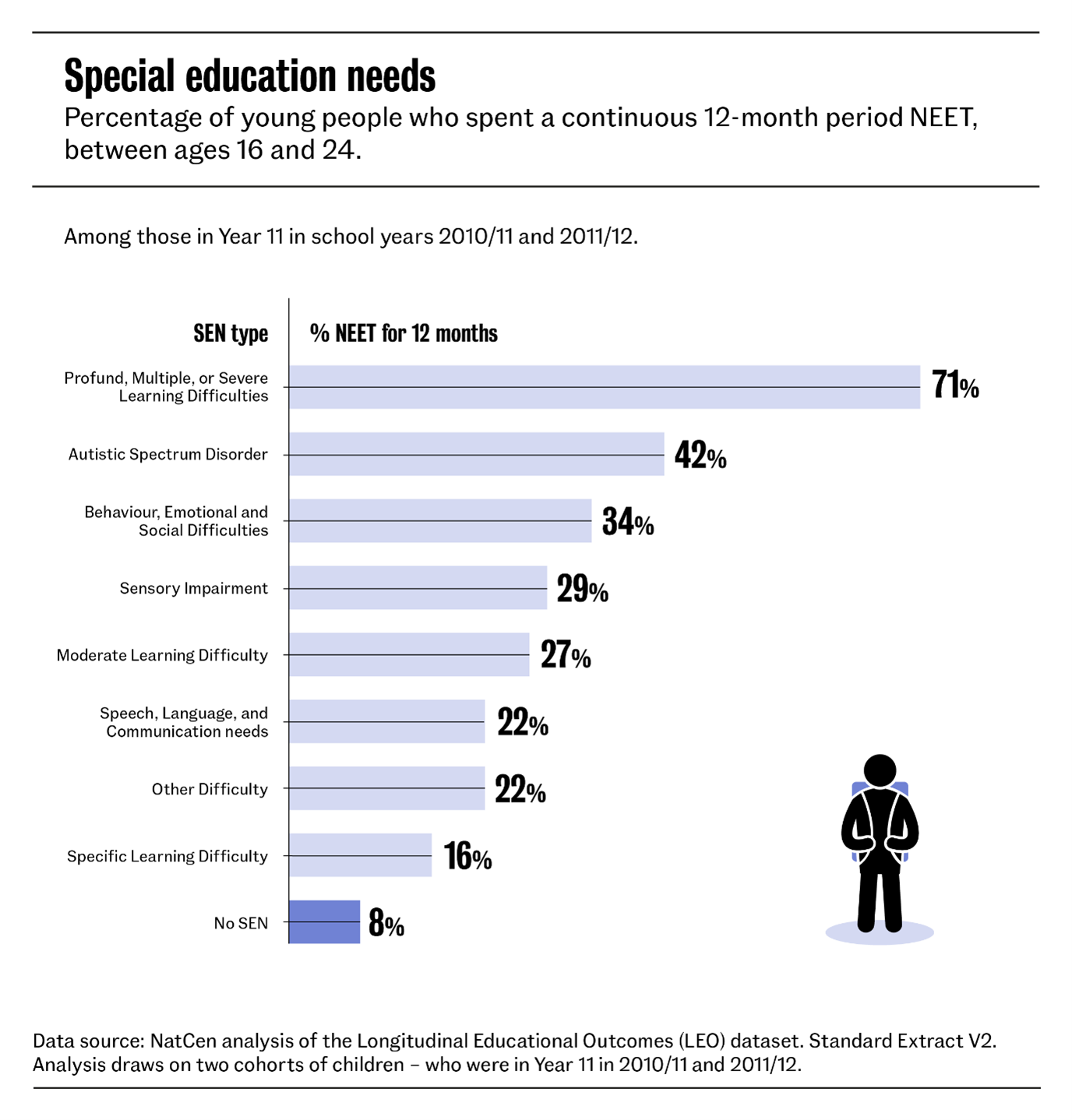
The findings highlight the importance of educational attainment, socio economic disadvantage, and Special Educational Needs (SEN) in shaping children and young people’s likelihood of becoming NEET. They also show that early support can make a meaningful difference: modelling suggests that timely, targeted intervention can substantially reduce NEET risk for young people facing multiple disadvantages. Together, these findings underline the value of early identification in preventing long term disengagement from education or work.
This study developed a predictive NEET Risk Index using a mixed methods approach, drawing on administrative data from over one million young people in England alongside qualitative research with practitioners. The study aimed to produce a scalable early-warning tool based on routinely collected administrative data.
The qualitative phase involved seven stakeholder interviews and five focus groups with practitioners across local authorities, education providers, and third-sector organisations. These discussions explored operational needs and identified key determinants of NEET risk. Insights were grounded in practical experience with the Risk of NEET Indicators (RONI) system used by Blackpool Council, which includes 15 indicators across five thematic domains.
The quantitative phase used administrative datasets accessed through the ONS Secure Research Service to ensure national scalability. Predictors were selected based on both empirical evidence and availability in routine data collections. Statistical modelling techniques were applied to estimate the relative contribution of each predictor to NEET outcomes, improving on earlier approaches that applied equal weighting to risk factors.
The resulting index produces a continuous risk score by aggregating weighted predictors. Model performance was evaluated using measures of predictive accuracy, model fit, and uncertainty, alongside consideration of subgroup variation (e.g. sex and ethnicity). The approach is informed by prior research from the research team that showed that young people typically experience multiple risk factors (on average, around four per individual), supporting the use of an additive risk framework but significantly building on its implement and accuracy.
 Article

